
Reviewed · WALKING TOURS
Sofia Hidden Gems: Small-Group Walking Tour with Tram Ride
Sofia reveals its best stories in layers: a Roman street under a modern square, a fourth-century church beside grand government buildings, and a centuries-old mosque near hot mineral springs. This small-group walk, capped with a short tram or metro ride, gives you a brisk introduction to the city’s complicated past. I like the small maximum of 10 people, which should make it easier to ask questions and keep up with the guide.
I also like the chance to step inside the National Library and Sofia University. Those interiors add something a standard photo stop cannot. Guide Peter is described as patient, energetic, and generous with extra sights and help, including time for souvenir shopping and a bottle of water.
The main tradeoff is pace. With roughly a dozen stops in two to three hours, many visits last only five or ten minutes. You will see a lot, but this is an orientation walk, not a museum tour with time to study every display.
Key points to know before booking
- Roman Sofia appears beneath the modern city: See the Rotunda of St. George and the Ancient Serdica complex, including part of the city’s main Roman street.
- Two worthwhile interior visits are included: The route goes inside the National Library and Sofia University, subject to normal operating conditions.
- The short public transport ride adds local texture: Your city transport card covers a brief tram or metro journey rather than a private vehicle transfer.
- The route crosses several eras: Orthodox churches, Ottoman architecture, Jewish Sofia, Socialist Classicism, Art Nouveau, and modern market life all appear in one compact walk.
- The group stays small: A maximum of 10 people makes this a more personal option than a large city sightseeing group.
- The finish is practical: The walk ends at Sofia Central Market Hall, close to a bus station and public transport.
Why this walk makes sense on a first day in Sofia
At $45.66 per person, this is not Sofia’s cheapest way to see the center. The value comes from the guide, the compact route, the public transport segment, and access to places you might otherwise pass without entering.
I would use this tour early in a Sofia stay. The opening stops help you get your bearings, while the guide can connect the city’s Roman, medieval, Ottoman, royal, Socialist, and modern chapters. Afterward, you can return to the cathedral, market, gallery, or archaeological complex that caught your attention.
The walk begins at Saint Sofia Church on Paris Street in the old city center. The itinerary includes travel time between locations, so the two to three hours are not spent standing at every monument. Wear comfortable shoes and bring suncream. The route is outdoors for much of the time, and the schedule has little spare time for slow browsing.
A few more Sofia trips to weigh up
- Sofia: Communist Walking Tour
★ 4.9 · 1,106 reviews - Sofia: City Monuments Guided Walking Tour with Audio Guide
★ 4.5 · 825 reviews - Communist Walking Tour of Sofia
★ 5.0 · 690 reviews
Saint Sofia Church and the city’s original name
Saint Sofia Church is a fitting starting point. The building dates to the fourth century, making it one of the oldest churches in Sofia. A predecessor church likely hosted the Council of Serdica in 343, attended by 316 bishops.
The church also explains the modern name of the city. Sofia was known as Serdika before the church gave its name to the capital in the fourteenth century. The stop lasts about 10 minutes and admission is free.
You should think of this as a short orientation rather than a full church visit. The guide’s explanation is the main benefit. If you want a slower look at the building, its religious art, or its archaeological setting, plan to return later.
Alexander Nevsky Cathedral and Sofia’s grand scale
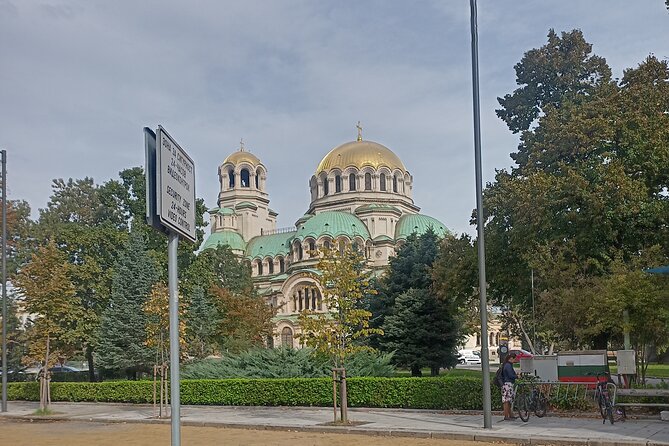
Next comes St. Alexander Nevsky Cathedral, Sofia’s most instantly recognizable church. Its Neo-Byzantine design and huge size give the center a ceremonial feel, quite different from the compact Roman remains later in the route.
The cathedral is one of the 50 largest Christian church buildings in the world by volume. The listed visit lasts about 10 minutes, with no admission charge included because the stop itself is free.
Ten minutes is enough to take in the exterior and hear the basic story. It is not enough for a careful look at every icon, architectural detail, or interior artwork. If the cathedral is high on your list, return independently when you have more time.
Kvadrat 500, the National Library, and Sofia University
The route then moves through Sofia’s cultural quarter. Kvadrat 500 is the newest and largest building of the National Gallery. It opened in 2015 and displays about 1,700 works from a collection of more than 42,000 pieces.
The galleries cover Bulgarian art from the mid-nineteenth century onward, European art from the fifteenth through nineteenth centuries, and works from Asia, Africa, and America. The schedule does not assign a timed gallery visit, so treat Kvadrat 500 as a visual and cultural stop rather than a full museum admission.
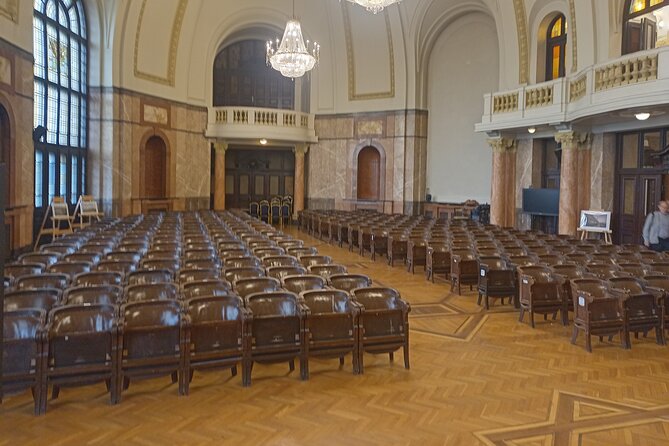
The National Library offers a different kind of experience. The St. St. Cyril and Methodius National Library holds nearly 8.5 million documents and receives about 70,000 new publications each year. You visit inside for about 10 minutes, which gives the building a practical role in the tour rather than leaving it as an exterior photograph.
That brief interior visit is one of the route’s best features. Sofia’s public buildings tell you how important education and written culture have been to Bulgaria. You will not have time to explore the collection, but you can see a working institution with national importance.
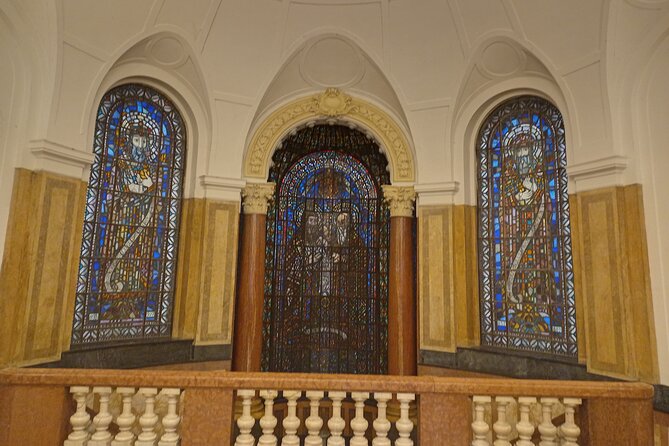
Sofia University St. Kliment Ohridski is also visited inside for around 10 minutes. It is Bulgaria’s first higher education institution, rooted in educational traditions that reach back to the ninth century and shaped further during the Bulgarian Renaissance.
Again, the value is context. This is not a campus tour or academic lecture. It is a quick look at a place tied to Bulgaria’s cultural development, and the guide can help connect it with the National Library and the country’s literary traditions.
Same country, a completely different kind of day:
- From Sofia: Rila Monastery & Boyana Church Day Tour
★ 4.7 · 5,107 reviews - From Sofia: Must-See Rila Monastery & Boyana Church Day Tour
★ 4.6 · 3,322 reviews - From Sofia: Guided Day Tour of Plovdiv’s Must-See Sights
★ 4.6 · 1,688 reviews - From Sofia: 7 Rila Lakes and Rila Monastery Extended Trip
★ 4.7 · 1,189 reviews
Architectural pauses around the theatre district
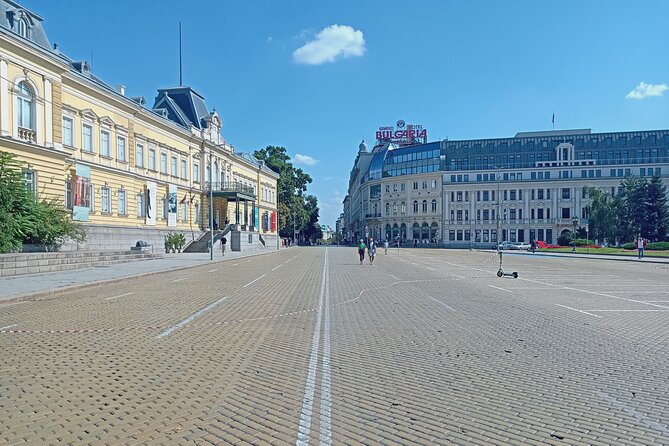
Several stops are described through their architecture and cultural role rather than given clear names in the schedule. One building was designed by Constantin Yovanovic between 1884 and 1886 in the Neo-Renaissance style. Yovanovic also designed Serbia’s Assembly building.
Another stop recalls the birth of Bulgarian opera. In 1890, Dragomir Kazakov, Ivan Slavkov, and Angel Bukoreshtliev organized the first Bulgarian opera troupe as an offshoot of the Sofia Drama and Opera Troupe. Its early performances included complete operas and excerpts, with Bulgarian, Czech, and Italian performers.
The National Theatre is another highlight of this section. Finished in 1906 and opened on January 3, 1907, it was designed by Ferdinand Fellner and Hermann Helmer in the Art Nouveau style. The auditorium seats 848, and the ceiling and walls were painted by Vienna-based artist Rudolf Fuchs.
These short pauses work best for visitors who enjoy city design and cultural history. If your priority is entering theatres or attending performances, the schedule does not promise that. You will see the exterior and learn why it matters.
The Largo and Sofia’s Roman foundations
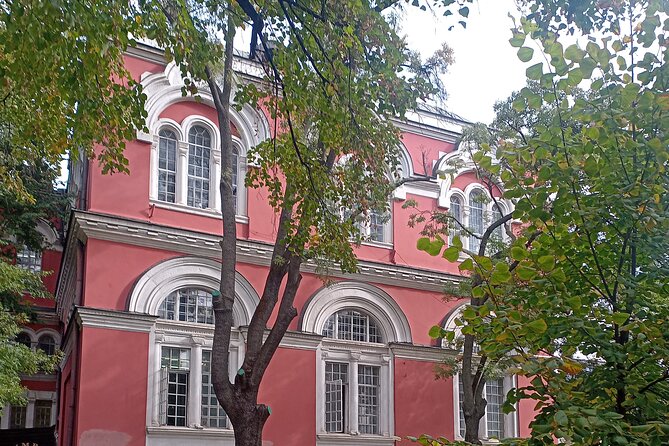
The Largo is Sofia’s central Socialist Classicist ensemble, built in the 1950s as the city’s new representative center. Three imposing buildings frame the area, creating one of the capital’s clearest examples of twentieth-century state architecture.
Below it, the Ancient Serdica Archaeological Complex brings the Roman city into view. The complex includes two zones, with archaeological remains incorporated into a public area beneath Nezavisimost Square.
You can see part of the decumanus maximus, one of Serdika’s main east-west streets. A large residential building occupied an entire city block, or insula, and included small shops where residents and passing visitors could buy food and goods. A lapidarium is located nearby.
The stop lasts about 15 minutes, making it one of the longer pauses on the route. That is useful because the ruins need a little time to make sense. You are looking at a real street plan, homes, shops, and city infrastructure, not an isolated monument.
The Rotunda of St. George and the Central Mineral Baths
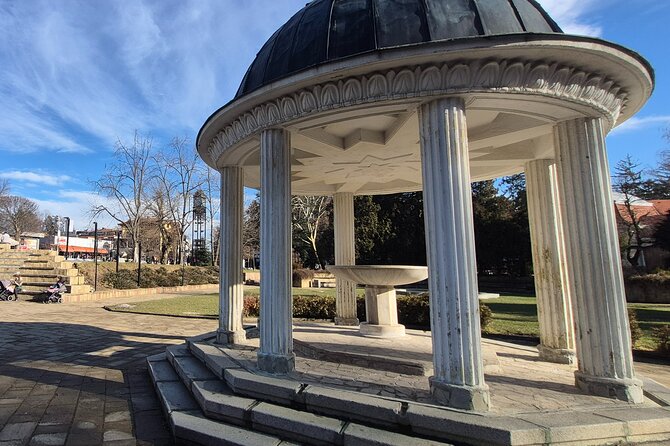
The Rotunda Church of St. George is one of Sofia’s most rewarding quick stops. This red-brick building was constructed in the early fourth century, originally as Roman baths, and later became a church inside the walls of Serdika.
It is considered the oldest building in modern Sofia and remains part of the Bulgarian Orthodox Church. The visit lasts around five minutes and is free.
Five minutes is short, but the building is compact and visually clear. I like the contrast here: ancient Roman construction, early Christian use, and a modern city surrounding it. If you are interested in architecture, this is another place worth revisiting at a slower pace.
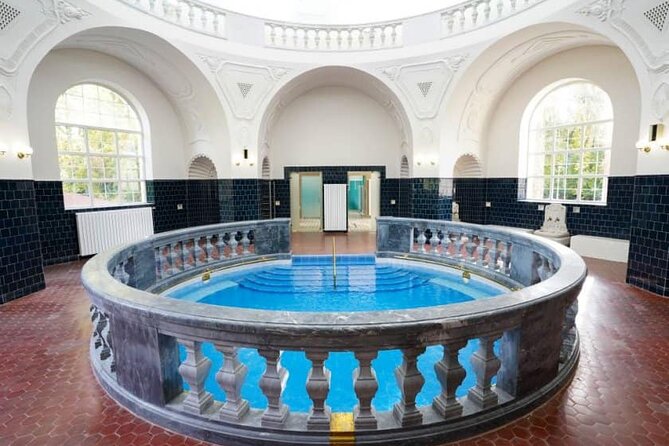
The Central Mineral Baths add a later chapter. The building, designed in 1904 and 1905 by Petko Momchilov and Friedrich Grünanger, uses the Vienna Secession style while adding Bulgarian, Byzantine, and Eastern Orthodox decorative touches.
The name is not accidental. Sofia is associated with hot mineral springs, and the bath building was designed around that local resource. The stop lasts 10 minutes at Banski Square, giving you time to examine the facade and hear how local design was blended with European fashion.
Jewish Sofia, the West Gate, and Ottoman Sofia
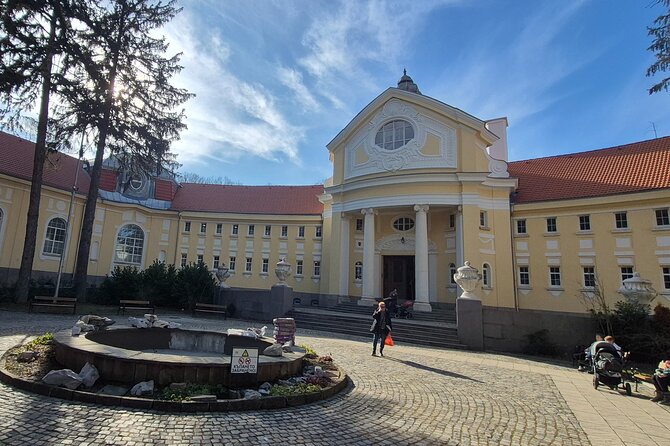
The Central Sofia Synagogue introduces another part of the city’s story. The Jewish community raised funds in the early twentieth century and invited Viennese architect Friedrich Grünanger to design the building. Construction took four years and cost 437,000 golden leva.
The base used stones from an old Jewish cemetery, and the names of the 10 leading contributors can be seen on the wall to the left after entering. The schedule describes the synagogue as a stop, but it does not specify the length or guarantee an interior visit, so you should not plan on a full synagogue tour from this walk alone.
The West Gate of Serdika is a compact archaeological stop between St. Joseph Catholic Cathedral, Todor Alexandrov Boulevard, and the city monument associated with Sofia. A pentagonal tower and a nearby triangular tower protect the preserved section of the fortress wall.
At about five minutes, this is another quick look at the Roman fortifications. It helps complete the picture begun at the Serdica complex, showing that the ancient city was not just a collection of houses and streets but a defended settlement.
The Banya Bashi Mosque brings Ottoman Sofia into the route. Built in 1576 by the Ottoman architect Mimar Sinan, it sits near the hot mineral springs. Its name refers to many baths.
This stop pairs naturally with the Central Mineral Baths. In a few blocks, you see how Sofia’s mineral water shaped both Ottoman and modern civic architecture. The itinerary does not state that you enter the mosque, so expect an exterior explanation unless the guide confirms otherwise.
Women’s Market and the finish at Central Market Hall
Zhenski Pazar, or Women’s Market, is Sofia’s oldest market, established more than 140 years ago. The tour allows about 10 minutes here.
That short visit gives you a look at everyday commerce rather than official monuments. It is a useful change of pace after churches, libraries, theatres, and government architecture. You might find produce, food, household goods, and local street scenes, but the schedule does not promise a tasting or shopping break.
The walk ends at Sofia Central Market Hall on Knyaginya Maria Luiza Boulevard, at the lower level. The location is close to a bus station, making it easier to continue sightseeing or return to your accommodation.
Ending at a market is a practical choice. You can stay for food or shopping, continue toward the city center, or use nearby transport. Allow yourself extra time if you want to browse, since the tour itself finishes rather than turning into a guided market visit.
Group size, transport, and the real pace
The group is capped at 10 people, and the tour is offered in English. A small group matters on a walking route with frequent stops, since you can usually hear the guide and ask about details without holding up a large crowd.
The tour includes a city transport card and a short tram or metro ride. This is not a sightseeing ride with a special route. It is a brief piece of ordinary Sofia transport, useful for covering ground and giving you a taste of how locals move around the center.
The duration is approximately two to three hours. The difference matters. A two-hour outing will feel quite brisk, while a three-hour version should allow more explanation and less rushing between stops. Since travel time is included, you should expect a moving city walk rather than long visits at every site.
Most people can participate, and the meeting point is near public transportation. The tour confirms your booking at the time of purchase. Free cancellation is available up to 24 hours before the local start time. Changes or cancellations inside that window are not refundable.
Who should book this Sofia walk
I would choose this tour if you want a strong first look at central Sofia and prefer stories to a simple list of photo stops. It suits first-time visitors, short-stay visitors, and anyone who wants help making sense of the city’s mixed architectural eras.
It is also a good fit if you like public institutions and overlooked corners. The National Library and Sofia University give the route more substance than a circuit of famous facades, while the tram or metro ride adds a small local touch.
I would look elsewhere if you want extended museum time, a food tour, or a slow architectural study. The route covers a lot, and the five and ten-minute stops require you to accept a quick introduction now and return later for deeper visits.
At $45.66, the price is reasonable if you use the tour as a city orientation and take advantage of the guide’s background. The value is weaker if you already know Sofia well or plan to visit each site independently. Guide Peter’s patient approach and willingness to answer questions make the experience especially appealing for visitors who want conversation rather than a memorized speech.
Should you book it?
Book this walk if you want Roman ruins, Orthodox landmarks, Ottoman architecture, Jewish Sofia, Socialist-era planning, cultural institutions, and markets tied together in one manageable outing.
The best reason to choose it is the combination of places: you step inside the National Library and Sofia University, see the Rotunda and Serdica ruins, ride public transport, and finish at a useful market location. Just keep your expectations realistic. This is a fast, guide-led introduction, not a series of full admissions.
FAQ
How long does the Sofia Hidden Gems walking tour last?
The tour lasts approximately two to three hours, including travel time between stops.
What language is the tour offered in?
The tour is offered in English.
How much does the tour cost?
The listed price is $45.66 per person.
What is the maximum group size?
The tour has a maximum of 10 travelers.
Where does the tour begin?
It begins at Saint Sofia Church, Old City Center, ul. Paris 2, Sofia.
Where does the tour end?
It ends at Sofia Central Market Hall, Knyaginya Maria Luiza Boulevard 25, on level minus one.
Is public transportation included?
Yes. The tour includes a city transport card and a short tram or metro ride.
Are admission tickets included at the listed stops?
The listed stops with admission details show free admission. The experience includes an English guide, but no separate paid museum admission is specified.
What is the cancellation policy?
You can cancel up to 24 hours before the local start time for a full refund. Cancellations or changes made less than 24 hours before the start are not accepted for a refund.
Just added around Sofia
- Veliko Tarnovo & Arbanasi Full day tour★ 5.0 · 5 reviews
- Private Winter Day Trip to the Rila Mountain★ 4.5 · 3 reviews
- Private transfer from Sofia to Plovdiv or vice versa★ 5.0 · 8 reviews
- Catacomb Tour in Sofia guided by a Local★ 4.5 · 3 reviews
- Tour to Koprivshtitsa and the Buzludzha monument incl the Seuthes Thracian Tomb★ 3.5 · 3 reviews
- Discover Sofia’s Unique Ancient Heritage – 5 Museums Included★ 5.0 · 3 reviews
- From Sofia: The gorges of Trun and Dragovski stone trail★ 5.0 · 6 reviews
- Private Day Trip to the Belogradchik Rocks and Fortress★ 4.5 · 6 reviews
Walking Tours, compared.
City Monuments Guided Walking Tour with Audio Guide
Read our review →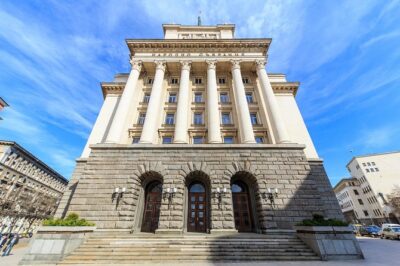
Sofia Highlights 2 Hour Sightseeing Walking Tour
Read our review →

Seven Rila Lakes Snowshoe Walk & Thermal Spring Pools
Read our review →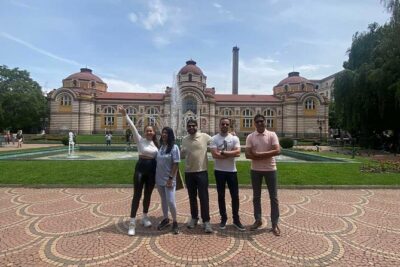
Browse the lists this tour appears in